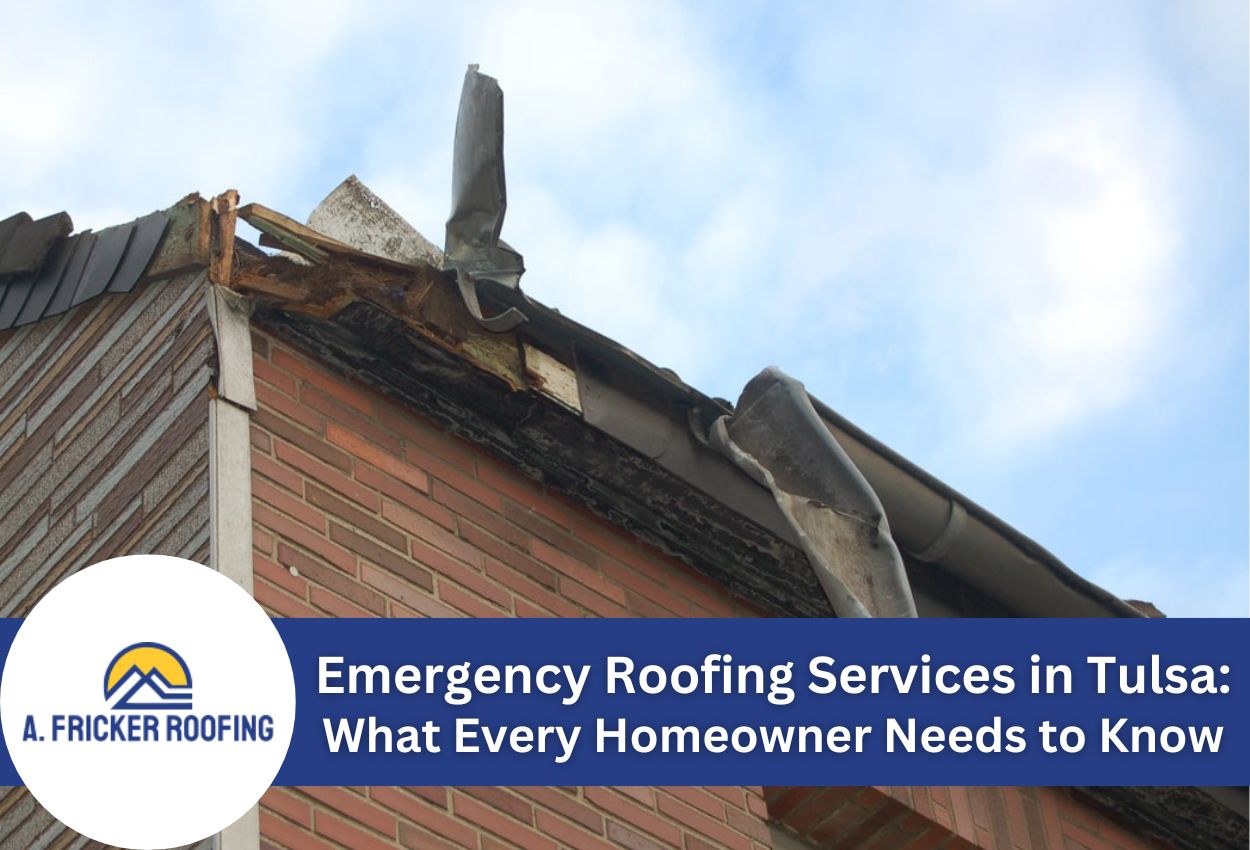

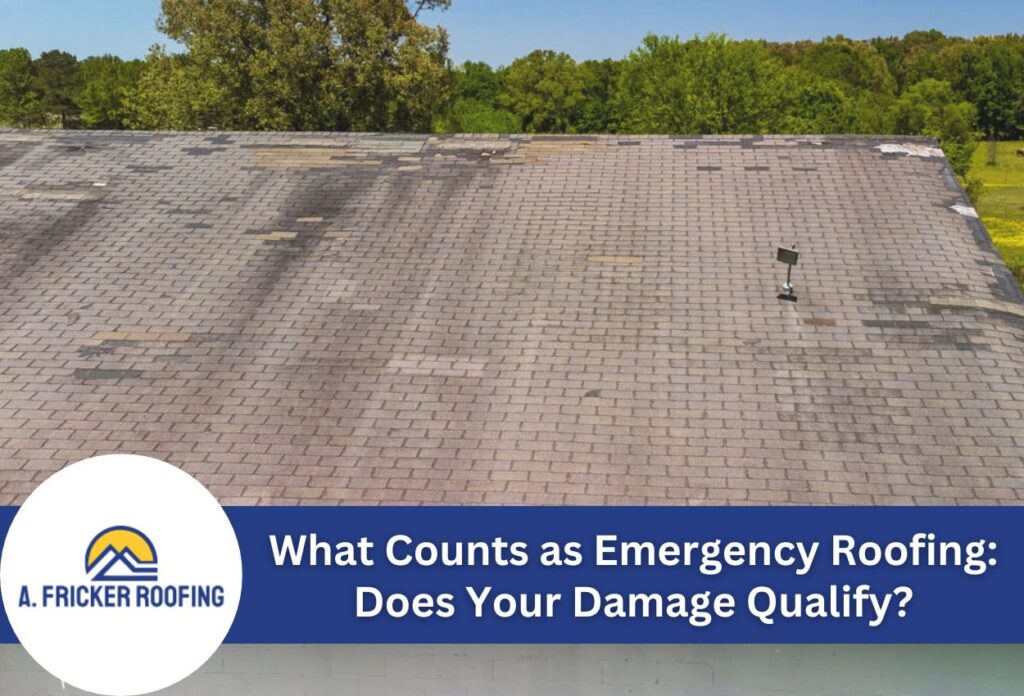

Emergency roofing means damage that creates an active path for water to enter your home, exposes structural roof decking, or puts the building’s frame at risk, and in Tulsa, most emergency calls happen in spring and early summer, when the region sees its highest hail and wind-damage frequency. If you’re not sure whether your situation qualifies, three conditions answer that question fast.
You have an emergency if any one of these is true: shingles are visibly missing or blown off, and roof decking is exposed to the sky; water is actively dripping or pooling inside your home right now; or the roofline shows sagging, impact damage, or signs of structural movement. Any single one of those conditions means waiting is not an option.
*Please note that price ranges listed in this article may not reflect the final cost of your project. Prices are subject to change based on various factors such as local labor rates, material quality, and more. All costs established in this article are rough estimates based on average industry rates.
Which Types of Roof Damage Actually Count as a Roofing Emergency?
Hailstones 1 inch or larger in diameter cause functional shingle damage, and wind gusts of 45 to 60 mph, common in Tulsa severe thunderstorms, are the range at which shingles begin to lift or displace, with the specific threshold depending on the shingle’s age, grade, and installation quality. Those two conditions cross the line into emergency territory; granule loss and minor cracking do not. Granule loss with no gap is a maintenance issue. Minor flashing gaps with no active leak can wait a week or two. Knowing the difference saves time and money.
| Damage Type | Emergency or Non-Emergency | Typical Response Window |
|---|---|---|
| Active interior leak | Emergency | Within 2 to 4 hours |
| Missing shingles exposing the roof deck | Emergency | Within 24 hours |
| Minor flashing gap with no active leak | Non-emergency | 1 to 2 weeks |
| Granule loss with no gap | Non-emergency | 2 to 4 weeks |
3-Point Ground-Level Field Check
Stay on the ground and run through these three checks before calling anyone:
- Visible daylight gaps: Stand back and scan the roofline. Any gaps where the sky shows through mean the roof decking is exposed right now.
- Ceiling stains spreading within hours: A stain that grows or darkens in under a few hours signals an active leak, not an old one.
- Sagging roof deck sections: Look along the roofline for any area that dips or bows; this points to structural damage that needs same-day attention.
If any 1 of these 3 checks comes back positive, the damage qualifies as an emergency. Contact a reputable Tulsa contractor like A. Fricker Roofing and Waterproofing the same day. Waiting even 24 hours with exposed roof decking or an active leak raises the risk of interior water damage and mold growth.
How to Tell If Storm Damage Qualifies for an Insurance Claim on Emergency Roof Repair
Oklahoma law (HB3495) sets the standard deadline at 2 years for wind and hail damage claims, with a 1-year minimum floor when damage is not evident without inspection. Some individual policy contracts may shorten the window, so review your policy language carefully, and the damage must be sudden and accidental, not the result of deferred maintenance or shingles already past 20 to 25 years of age.
- Photograph everything with timestamps: Take dated photos of all visible damage, missing shingles, exposed roof decking, and impact marks before anything is moved or covered. Timestamp metadata from your phone is acceptable documentation for most Oklahoma insurers.
- Record the storm date and verify it: Note the exact date the storm hit and cross-reference it with a NOAA storm record for the Tulsa area. This ties your damage to a specific storm, which is what adjusters need to approve a claim.
- Collect interior damage evidence: Photograph water stains on ceilings, wet insulation in the attic, or any interior pooling. Interior evidence supports the argument that the roof opening was sudden, not a slow leak from long-term wear.
- Do not make permanent repairs before the adjuster inspects: Completing permanent repairs before an adjuster sees the roof can void your claim. Temporary fixes, tarping, and board-up are allowed and expected.
- Get a written estimate from a licensed Oklahoma roofing contractor: A contractor-prepared damage estimate gives the adjuster a cost baseline and confirms the scale of the emergency.
Insurers typically cover emergency temporary repairs, tarping, and board-up up to $1,000 to $2,500 in immediate mitigation costs under most standard HO-3 policies, as long as those costs are documented. Permanent repairs require adjuster approval first; skipping that step is the most common reason Tulsa homeowners lose reimbursement on otherwise valid claims. For guidance on navigating the process, review what’s involved in filing an emergency roofing insurance claim before contacting your carrier.
What Is a Temporary Roof Fix After a Storm, and How Long Does It Actually Last?
Two temporary solutions handle most Tulsa storm emergencies: polyethylene tarping and peel-and-stick patch membrane, and how long they last depends entirely on which type is used and how fast a crew gets it down.
- Assess and document before covering: Photograph all exposed roof decking, missing shingles, and impact marks before tarping begins. This protects your insurance claim and takes less than 10 minutes.
- Clear the damaged area: Remove loose debris, broken shingles, and standing water from the affected section so the tarp or membrane sits flat against the roof deck’s surface.
- Extend the tarp at least 4 feet past the damaged area on all sides: Anything less leaves edges vulnerable to wind uplift. Post-storm straight-line windstorms in Tulsa can exceed 45 mph, which will pull an undersized tarp off within hours.
- Secure the tarp over the ridge: Fastening at the ridge peak is the most important step, as an unsecured ridge edge is the primary failure point in wind conditions.
- Choose the right material for your timeline: Standard 6-mil poly tarps hold 30 to 90 days before Tulsa’s UV exposure and summer heat cause degradation. Contractor-grade 10- to 12-mil tarps extend that window to 3 to 6 months. Peel-and-stick bituminous patch membrane, installed over clean roof decking, can bridge 6 to 12 months.
Tulsa-area contractors typically deploy tarping crews within 2 to 6 hours of an emergency call during active storm season (April through June). Waiting longer than 24 hours after a roof gap during Tulsa’s humid summer months raises the risk of mold beginning within 24 to 48 hours of sustained moisture exposure, a problem that turns a roofing bill into a roofing and remediation bill.
What Does Emergency Roofing Cost in Tulsa, and What Affects the Price?
Emergency roofing costs in Tulsa range from $200 for a basic flashing repair to $4,500+ for full structural stabilization, and after-hours or storm-season calls add a 20% to 40% premium on top of standard daylight-hours labor rates.
| Service | Typical Cost Range | Average Time to Complete | Typically Covered by Insurance |
|---|---|---|---|
| Emergency tarping | $300 to $700 | 1 to 3 hours | Partial (up to policy limit) |
| Partial shingle replacement (up to 10 squares) | $400 to $1,200 per square | 4 to 8 hours | Yes (if storm-caused) |
| Flashing repair or resealing | $200 to $600 | 1 to 2 hours | Partial |
| Full emergency stabilization with structural assessment | $1,500 to $4,500+ | 6 to 12 hours | Yes (adjuster approval required) |
Oklahoma wind and hail claim deductibles commonly run $1,000 to $2,500 or 1 to 2% of total dwelling coverage, meaning smaller repairs like tarping or flashing fixes may fall below that threshold entirely and come straight out of pocket. Knowing your deductible before calling your insurer helps you decide whether filing a claim makes financial sense for a lower-cost repair. For larger jobs, full stabilization or multi-square shingle replacement filing almost always makes sense, but document everything first, as covered in the section above.
Is It Worth Paying for Emergency Roofing Now, or Can It Wait?
Paying for a $300 to $700 emergency tarp deployment now is almost always cheaper than the $10,000 to $20,000+ in continuous repair costs that follow 1 to 2 weeks of unaddressed damage. The math is straightforward. An active leak left alone in Tulsa’s humid summer climate can trigger mold growth within 48 to 72 hours, and mold remediation alone runs $1,500 to $6,000. Add structural roof decking replacement at $2 to $5 per square foot and interior drywall and insulation repair averaging $800 to $2,500 per room, and the delay penalty adds up fast.
| Action Taken | Typical Total Repair Cost | Key Risk if Delayed |
|---|---|---|
| Tarp deployed within 24 hours | $3,000 to $8,000 | Minimal if acted on quickly |
| No action for 1 to 2 weeks | $10,000 to $20,000+ | Mold, structural decay, interior damage |
| Mold remediation only | $1,500 to $6,000 | Grows worse with each rainstorm |
| Drywall and insulation replacement | $800 to $2,500 per room | Often not covered if the delay is documented |
Insurers expect quick mitigation action waiting weeks before calling a contractor is a documented reason carriers reduce or deny interior damage claims. There is one more factor to weigh: asphalt shingles in Tulsa typically last 15 to 25 years, depending on ventilation quality and storm exposure. If emergency damage hits a roof that is already 18 to 20 years old, repeated patching rarely pencils out against a licensed contractor’s assessment. An emergency visit should include an honest age-and-condition evaluation to help you decide between repair and full residential roof replacement.
Need Emergency Roofing in Tulsa? Here’s How to Get Help Fast
If your roof has an active leak, missing shingles, or a storm opening the three conditions most likely to cost you $10,000 to $20,000+ if left unaddressed. Tulsa’s spring and early summer storm season makes a same-day response the right call, not a cautious one.
A. Fricker Roofing and Waterproofing serves Tulsa homeowners with same-day emergency assessments, 24/7 emergency tarping, and full hail-damage roof repair. The team also provides written damage documentation to support your Oklahoma homeowner insurance claim, giving your adjuster the cost baseline and job scale confirmation needed to move your claim forward.
Schedule your free storm inspection.
Not ready to schedule? Learn more about emergency roofing services.