
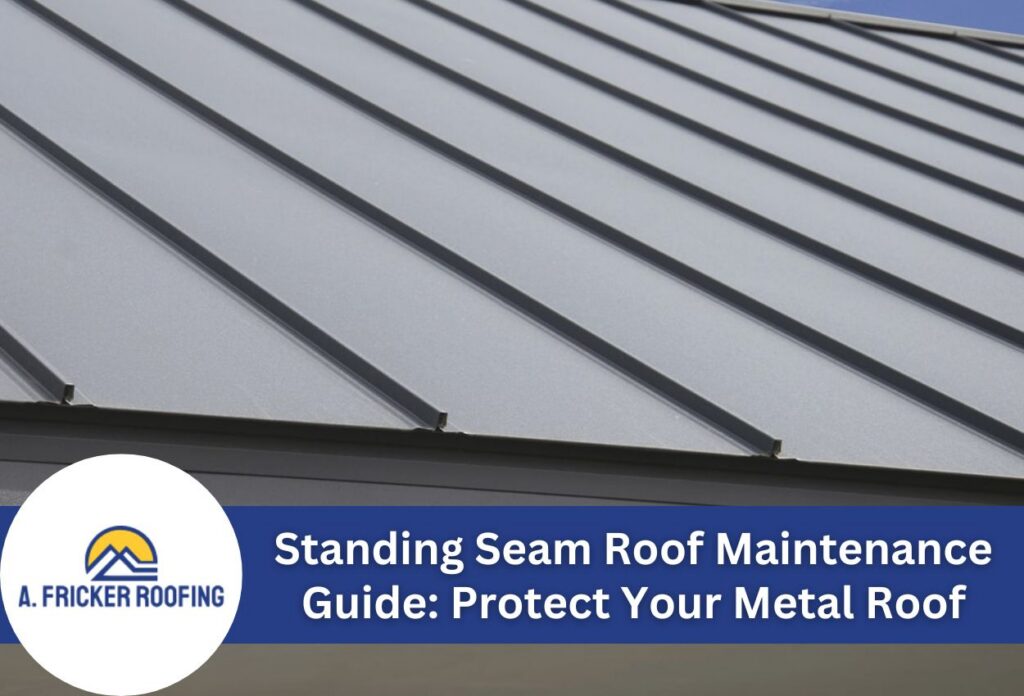

Standing seam metal roofs last 50 to 70 years with proper maintenance, more than double the 15- to 30-year lifespan of asphalt shingles, but only if they receive the right care at the right times.
Tulsa’s climate is hard on roofs. The area sees 40 to 45 inches of rain per year, summer relative humidity that commonly runs 60% to 70%, and an active severe weather season that brings hail, high winds, and tornado risk. Those conditions put real stress on seams, flashings, coatings, and drainage systems year after year.
*Please note, price ranges listed in this article may not reflect the final cost of your project. Prices are subject to change based on various factors such as local labor rates, material quality, and more. All costs established in this article are rough estimates based on average industry rates.
How Often Should You Inspect a Standing Seam Metal Roof in Tulsa?
Inspect a standing seam metal roof at least twice a year, once in spring (March to April) and once in fall (October), because both seasons fall before and after Tulsa’s primary severe weather window, when temperatures are moderate enough for safe rooftop work. Most standing seam manufacturer warranties also require documented inspections every 1 to 2 years to keep coverage active. A professional roof inspection typically costs $150 to $400 for a residential roof, a fraction of the $1,500 to $5,000+ you could face in storm damage repairs if problems go undetected.
| Inspection Type | Timing | Primary Focus |
|---|---|---|
| Spring inspection | March to April | Winter moisture damage, seam movement, and flashing condition |
| Fall inspection | October | Summer coating wear, debris buildup, gutter, and drainage condition |
| Post-storm inspection | Within 48 to 72 hours after any hail or wind storm exceeding 50 mph | Dents, loosened clips, displaced trim, flashing gaps |
Tulsa averages 2 to 3 major hailstorms per year at any specific location, and hail damage left unaddressed beyond 12 months can void the coating warranty on metal panels. Scheduling a post-storm inspection within 48 to 72 hours after any significant hail or high-wind storm is the single most important step Tulsa homeowners can take to protect both their roof and their warranty coverage. If you are unsure whether a storm crossed the 50 mph wind threshold, check the nearest National Weather Service report for your zip code before deciding to skip the inspection.
What Does a Standing Seam Metal Roof Maintenance Checklist Include?
A thorough standing seam metal roof maintenance checklist covers three categories: surface and panel checks, seam and fastener checks, and drainage checks, and every completed checklist should be documented and dated to satisfy both warranty and homeowners insurance requirements.
- Surface and panel condition: Look for dents, scratched coating, and rust spots across every panel. Rust spots larger than 1/4 inch should be treated right away. Left untreated, they can spread under the coating and weaken the panel over time.
- Coating wear from summer heat: Tulsa’s summer UV exposure accelerates coating breakdown on south- and west-facing panels. Check for chalking or fading, which signals the coating’s protective layer is thinning and may need spot treatment within the next inspection cycle.
- Seam and clip structural integrity: Inspect standing seams for any separation, cracking, or signs that clips have disengaged. Clips that lose engagement allow panels to shift, which puts stress on the seams during Tulsa’s high-wind storms exceeding 50 mph.
- Ridge cap and trim fasteners: Check ridge caps and all trim pieces for fasteners backing out. Even one loose fastener at the ridge can allow water intrusion during a heavy rainstorm.
- Sealant and caulk at gaps and flashings: Tulsa’s temperature swings of 40 degrees to 60 degrees Fahrenheit between seasons accelerate sealant degradation around pipe boots, skylights, and flashing edges. Replace any sealant that is cracked, peeling, or pulling away from the surface.
- Debris from deciduous trees: Fallen leaves and small branches accumulate on low-slope sections and in valleys every fall. Clear all debris before the rainy season arrives. Organic buildup holds moisture against the coating and speeds surface wear.
- Gutters and downspout drainage: After every rainfall, water should clear the gutters and downspouts fully within 24 hours. Standing water that remains longer than 24 hours points to a blockage or slope problem that needs correction before it causes pooling damage at the eaves.
Running through this standing seam metal roof maintenance checklist twice a year, from March to April and again in October, keeps small issues from turning into expensive repairs. Log each inspection with dates, photos, and any corrective action taken so the record is ready if a warranty or insurance claim ever comes up.
What Are the Most Common Standing Seam Roof Problems and How Are They Fixed?
The five most common standing seam roof problems in Tulsa are panel denting, sealant failure, coating wear, fastener loosening, and edge corrosion; each ties directly to a specific local climate stress, and understanding common standing seam roof problems and maintenance solutions starts with knowing which issues most frequently affect older homes with complex roof transitions. Pre-1980 Tulsa homes with multiple valleys, dormers, or mixed roofing materials are especially prone to sealant failure and corrosion at cut edges, where dissimilar materials meet, and moisture collects.
| Problem | Primary Cause in Tulsa Climate | DIY-Addressable | Estimated Repair Cost Range |
|---|---|---|---|
| Panel denting from hail | 50+ hail days per year during severe weather season | No | $300 to $1,500 per panel section |
| Sealant failure at gaps | Temperature swings of 40 degrees to 60 degrees between seasons accelerate sealant breakdown | Yes, surface-level cracks only | $75 to $350 per gap |
| Surface coating wear or chalking | 220+ sunny days per year; UV exposure on south- and west-facing panels | No coating reapplication requires professional equipment | $1,200 to $4,000 for spot recoating |
| Clip or fastener loosening from thermal expansion | The annual temperature range of 28 degrees to 95 degrees causes repeated panel movement | No requires proper torque tools and clip knowledge | $200 to $900 per roof section |
| Corrosion at cut edges or transitions | 40 to 45 inches of annual rainfall plus humidity of 60% to 70% in summer | No, especially in pre-1980 homes with complex transitions | $400 to $2,000 depending on extent |
Most of these problems develop slowly and stay hidden until they cause interior damage. Sealant failure and fastener loosening are the most frequent calls A. Fricker Roofing and Waterproofing receives from Tulsa homeowners, largely because both get worse quickly during active storm seasons. Corrosion at cut edges is the costliest problem to ignore. What starts as a $400 repair can escalate to $2,000 or more once moisture spreads beneath the panel coating. Catching any of these issues at the first or second inspection cycle costs far less than addressing them after water intrusion has already begun.
How Do You Clean and Maintain a Standing Seam Metal Roof Without Causing Damage?
Clean a standing seam metal roof once per year for standard exposures, or twice per year if the roof has heavy tree coverage, north-facing slopes, or sits in a humid climate, and always use low-pressure washing at 1,200 to 1,500 PSI with a mild detergent rated between pH 6 and 9. Pressure washing above 2,000 PSI can strip PVDF or SMP paint coatings and void manufacturer warranties.
- Use low-pressure washing only: Keep pressure between 1,200 and 1,500 PSI with a wide-angle nozzle. Anything above 2,000 PSI risks stripping the factory coating. Once the coating is damaged, recoating costs $1,200 to $4,000 for spot repairs.
- Choose the right cleaning solution: Use a mild detergent with a pH range of 6 to 9. Acidic or alkaline cleaners outside that range can degrade panel coatings and affect the long-term appearance of the surface of the roof.
- Use soft-bristle brushes for scrubbing: Metal-bristle brushes and abrasive pads scratch the coated surface. Soft-bristle brushes remove debris and buildup without cutting through the protective layer.
- Inspect for biological growth every spring: Tulsa’s summer relative humidity of 60% to 70% creates conditions where moss, algae, and organic growth develop, especially on shaded or north-facing sections. Inspect after the wet fall and winter period and treat any growth with zinc sulfate or an approved algaecide applied at concentrations listed on the product label.
- Clear debris before washing: Remove leaves, branches, and dirt by hand or with a soft-bristle broom before applying water. Wet organic debris pressed against the coating holds moisture and speeds surface wear between cleaning cycles.
- Rinse in the direction of panel seams: Always rinse downward along the panel, not across seams. Forcing water sideways into standing seams under pressure can push moisture under the seam cap and into the roof decking.
This standing seam roof cleaning and upkeep guide applies whether you handle cleaning yourself or schedule a professional. Roofs with heavy tree coverage or north-facing slopes in Tulsa’s humid climate should be cleaned twice per year. Skipping cycles allows biological growth to take hold and shortens the life of the panel coating.
Does Regular Standing Seam Roof Maintenance Actually Save Money Over Time?
Yes, professional annual maintenance reduces total 20-year ownership costs by thousands of dollars compared to skipping maintenance entirely, and the numbers below show exactly why knowing how to maintain a standing seam metal roof pays off in real dollars.
| Scenario | Annual Maintenance Cost | Expected Roof Lifespan | Estimated Total Repair Costs Over 20 Years | Total 20-Year Cost of Ownership |
|---|---|---|---|---|
| No Maintenance | $0/year | 25 to 30 years | $8,000 to $15,000 | $8,000 to $15,000 |
| Basic DIY Maintenance | $100 to $200/year | 40 to 50 years | $2,000 to $4,000 | $4,000 to $8,000 |
| Professional Annual Maintenance | $300 to $500/year | 50 to 70 years | $500 to $1,500 | $6,500 to $11,500 |
Standing seam roofs cost $15,000 to $35,000 installed on a typical Tulsa residential property. A $300 to $500 annual maintenance investment on a $25,000+ asset works out to approximately 1% to 2% of the roof’s value per year while cutting repair costs by as much as $13,500 over 2 decades compared to doing nothing. Documented maintenance records also support homeowners’ insurance claims after a storm, giving you proof that the roof was properly cared for before damage occurred. The math strongly favors consistent professional upkeep over reactive repairs.
When Should You Call a Tulsa Roofing Contractor Instead of Handling Maintenance Yourself?
Call a professional roofer when any one of these five conditions applies. DIY standing seam roof inspection and repair tips only go so far, and certain thresholds signal damage that requires a contractor experienced with concealed-fastener systems specifically.
- Visible panel separation or lifted seams longer than 6 inches: Seams that have opened or panels that have shifted more than 6 inches need professional re-engagement. Concealed-fastener systems use clips and hidden attachment points; exposed-fastener repair techniques are not compatible and can permanently compromise the panel lock.
- Active leaks or water stains on interior ceilings: Any water stain indoors means the system has already been breached. Stopgap sealing is not enough. A contractor needs to trace the entry point and restore the full seam or flashing assembly.
- Hail dents covering more than 10% of the panel surface area: Dents at this level affect drainage paths and the coating’s structural integrity across a wide area. This threshold also matters for insurance: a professional inspection report documenting damage within 30 to 60 days of a Tulsa hail or wind storm strengthens insurance claims and aligns with most Oklahoma homeowner policy reporting windows.
- Corrosion getting through the metal surface: Surface oxidation can sometimes be treated. Corrosion that has eaten through the base metal, not just discolored the coating, requires panel replacement, not surface treatment.
- Any roof access on pitches steeper than 4:12: Slopes above 4:12 require proper fall protection equipment and roof-walking experience. Foot traffic on steep standing seam panels without the right gear risks both injury and panel damage.
When hiring in Tulsa, verify that the contractor has direct experience with concealed-fastener standing seam systems. A. Fricker Roofing and Waterproofing works with these systems specifically, not just standard exposed-fastener metal roofing systems, which matters when the seam’s structural integrity and clip alignment are on the line.
Ready to Protect Your Standing Seam Roof? Contact Our Tulsa Roofing Team Today.
A $300 to $500 annual inspection is one of the lowest-cost ways to protect a $25,000+ roof asset, and scheduling it in spring or fall gives Tulsa homeowners the best window before severe weather season arrives. A. Fricker Roofing and Waterproofing serves the greater Tulsa, OK, area and works specifically with concealed-fastener standing seam systems, so inspections cover the seams, clips, and transitions that matter most. With proper professional care, a standing seam roof can last 50 to 70 years, making a quick call now one of the smartest decisions a property owner can make.
Schedule your free roof inspection.
Not ready to schedule? Learn more about our standing seam roof maintenance program.